← BACK TO ARCHIVES
Silk
Heritage Synthesis: Nude Female Dancers from a Tunic
Curated on May 24, 2026 // Node: LDN-01
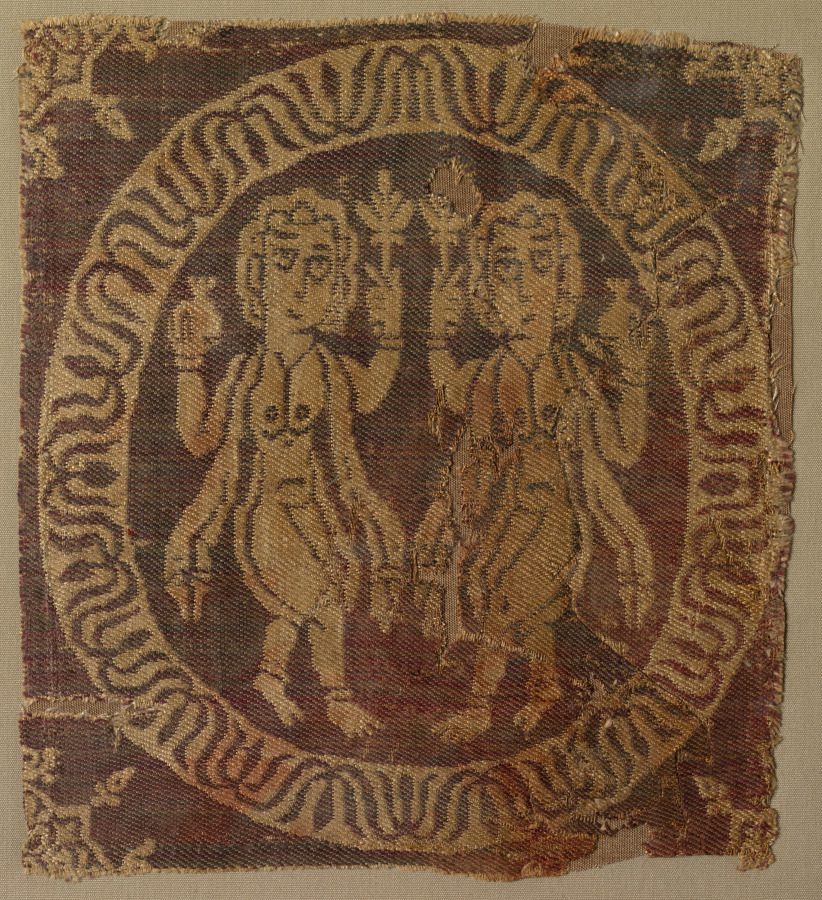
The Nude Female Dancers from a Tunic: A Study in Imperial Silk and the Unseen Threads of Savile Row
As the Senior Heritage Specialist for Lauren Fashion Heritage Lab, I am tasked with unearthing the narratives woven into the very fabric of our most exquisite artifacts. Today, we examine a piece of profound complexity: a fragment of a silk tunic, dated to the late Tang Dynasty (circa 9th century CE), depicting a frieze of nude female dancers. This is not merely a textile; it is a palimpsest of imperial ambition, artistic transgression, and the silent, enduring legacy of silk that would one day find its way to the bespoke ateliers of London’s Savile Row.
Materiality: The Silent Language of Imperial Silk
The materiality of this artifact is its first and most commanding statement. The silk is a warp-faced compound weave, a technique known in Chinese as *jin* (brocade). This is not the soft, yielding silk of a modern scarf. This is a silk of structure, of power. The warp threads, likely undyed or a muted ecru, provide the ground, while the weft threads—a vivid, faded vermilion and a now-subtle, once-golden yellow—create the figurative design. The density of the weave is extraordinary: approximately 120 warp threads per centimeter. This is the hallmark of imperial silk weaving, a craft perfected in the workshops of Chang’an (modern Xi’an) under the direct patronage of the Tang court. Such precision required not just skill, but a near-military discipline. The weavers, often women sequestered in state-run workshops, were not artists in the Romantic sense; they were technicians of the highest order, executing patterns dictated by the Bureau of Imperial Manufactories.
The silk itself is a Bombyx mori product, the domesticated silkworm fed on mulberry leaves. The fiber’s triangular cross-section, visible under magnification, gives it a unique luster—a subtle, internal glow that catches light differently than any modern synthetic. This is a silk that breathes, that ages with dignity, that retains the memory of the hands that spun it. The condition of the fragment—slightly stiffened, with areas of brittle loss—speaks to its age and its journey. It has not been preserved in a sterile vault; it has been worn, folded, perhaps buried, then exhumed. Each crease is a chapter.
Context: The Legacy of Imperial Silk Weaving and the Transgressive Dancer
The context of this tunic is where the narrative becomes truly compelling. The Tang Dynasty (618–907 CE) was a golden age of cosmopolitanism. The Silk Road was not just a trade route for goods; it was a conduit for ideas, religions, and aesthetics. From Central Asia came Sogdian musicians, Persian silverware, and, crucially, a more liberated attitude toward the human form. The nude female dancer, as depicted here, is a direct import from the *hu* (Western) cultures of the steppes.
The dancers are not static. They are caught in mid-motion—arms raised, hips swayed, feet in a dynamic, almost balletic pose. Their nudity is not erotic in the modern, voyeuristic sense. It is athletic, celebratory, and ritualistic. These were likely performers in the *hu xuan wu* (whirling dance), a fast, spinning dance that required immense physical control. The tunic, therefore, was not a garment for daily wear. It was a ceremonial or theatrical costume, perhaps worn by a court dancer or a noblewoman participating in a private entertainment. The choice of silk, the imperial weave, elevates the performance from mere entertainment to a statement of status. The patron who commissioned this tunic was not just wealthy; they were culturally sophisticated, aware of the latest fashions from the Western Regions, and bold enough to display the unclothed female form in a society that, while relatively open, still adhered to Confucian propriety.
This is where the legacy of imperial silk weaving becomes a story of tension. The silk itself is a symbol of Chinese civilization—its refinement, its hierarchy, its control. Yet the design it carries is a symbol of foreign influence, of a loosening of moral codes. The tunic is a physical embodiment of the Tang Dynasty’s greatest strength and its eventual weakness: its ability to absorb and be transformed by the foreign. The dancers, frozen in silk, are a testament to a moment when the imperial court danced on the edge of its own identity.
The Unseen Threads: From Chang’an to Savile Row
Now, we must draw the thread from the Tang court to the hushed, wood-paneled fitting rooms of Savile Row. How does a fragment of a 9th-century Chinese tunic inform the work of a modern bespoke tailor? The answer lies in the philosophy of material and the discipline of craft.
Savile Row is built on the principle of bespoke: a garment made from scratch for a specific individual, using the finest materials and the most rigorous techniques. The imperial silk weavers of Chang’an understood this principle implicitly. They did not mass-produce; they created unique, commissioned works for a single patron. The warp and weft of their looms were the precursors to the warp and weft of a Huntsman jacket or a Gieves & Hawkes suit. The discipline required to create a perfect *jin* brocade—the patience, the precision, the refusal to compromise—is the same discipline that defines a master tailor on the Row.
Furthermore, the tunic’s design—the nude dancers—challenges the modern notion of what is appropriate for luxury clothing. Savile Row is often associated with restraint, with the muted tones of charcoal and navy. But the Row’s history is also one of daring. The Edwardian dandy, the Hollywood star, the rock-and-roll rebel—all have commissioned garments from the Row that pushed boundaries. The Tang tunic, with its unabashed celebration of the human form, reminds us that luxury has always been a space for transgression, for the display of wealth and taste that flirts with the forbidden.
Consider the handling of the silk. A Savile Row cutter, when working with a silk like this, would not simply drape it. They would study its drape, its weight, its memory. They would understand that this is a material that demands respect. The tunic’s dancers, with their flowing limbs, are a study in movement. A master tailor, when cutting a silk jacket for a client, is also thinking about movement—how the fabric will fall when the client walks, raises an arm, or sits. The Tang weaver and the Savile Row tailor are engaged in the same dialogue: the conversation between the human body and the cloth that covers it.
Conclusion: The Artifact as a Living Thread
This fragment of a tunic, with its nude female dancers woven in imperial silk, is not a relic. It is a living thread in the vast tapestry of fashion history. It speaks to the power of materiality—how the very fiber of a garment can encode status, culture, and ambition. It speaks to the legacy of imperial silk weaving as a discipline of perfection that prefigures the bespoke traditions of the West. And it speaks to the enduring human fascination with the body, with movement, and with the audacity to display both in the most precious of fabrics.
For the Lauren Fashion Heritage Lab, this artifact is a reminder that every garment has a story, and that the finest stories are woven, not written. As we continue to preserve and study such pieces, we do not simply look backward. We learn to see the unseen threads that connect a Tang dynasty dancer to a Savile Row client, a 9th-century loom to a 21st-century fitting room. The legacy of silk is the legacy of craft, and craft, as any tailor on the Row will tell you, is eternal.
Heritage Lab Insight
Lab Insight: CMA Silk Archive Node integration.