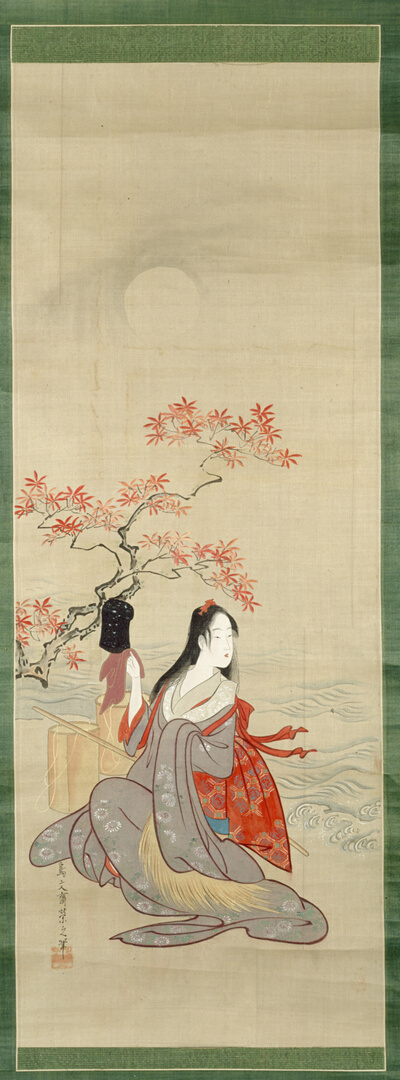
The Salt Maidens, Murasame with Yukihira’s Hat: A Study in Silk, Narrative, and the Art of Transience
Introduction: The Convergence of Craft and Story
In the hushed, wood-paneled ateliers of London’s Savile Row, where the weight of a cloth is measured in decades of tradition, one learns to read the language of textiles. A bolt of worsted wool speaks of discipline; a length of cashmere, of quiet luxury. But silk—particularly the ink-and-color-on-silk tradition of Japanese hanging scrolls—speaks a more nuanced dialect. It is a language of fluidity, of breath, of a moment suspended in time. The artifact before us, The Salt Maidens, Murasame with Yukihira’s Hat, is not merely a painting; it is a heritage document, a textile narrative that weaves together the threads of classical Japanese poetry, the ephemeral nature of beauty, and the masterful hand of a silk artisan. As a Senior Heritage Specialist, I approach this work with the same rigor and reverence one might apply to a bespoke suit from Huntsman or a vintage Hermès scarf: examining its materiality, its provenance, and the story it tells through every fiber.
Materiality: The Silk Canvas as a Living Surface
The foundation of this artifact is its materiality. A hanging scroll, or kakemono, is not a static object; it is a performative piece, designed to be unrolled, viewed, and re-rolled, its silk surface breathing with the humidity of the room. The support is a finely woven silk, likely a haku or rinzu weave, chosen for its even absorbency and subtle luster. The warp and weft threads are so fine that the canvas appears almost translucent, a deliberate choice that allows the ink and mineral pigments to sit upon the surface like a whisper. The silk is not merely a substrate; it is an active participant in the composition. The fluidity of the brushwork—the way the ink bleeds into the fibers, creating soft edges and organic gradients—mirrors the very essence of the subject: the salt maidens, or shio no onna, who harvest salt from the sea, their bodies and garments perpetually damp with brine and mist.
The pigments used are traditional iwa-enogu, ground from minerals such as azurite for blues, malachite for greens, and cinnabar for reds. These are bound with animal glue, or nikawa, and applied in thin, layered washes. The result is a surface that glows with an internal light, the colors shifting as the viewer moves. The ink, or sumi, is derived from soot and is used not only for outlines but for atmospheric effects—the suggestion of rain, the weight of a hat, the shadow of a passing cloud. The silk, with its natural off-white tone, serves as the “white” of the composition, a negative space that is as active as the painted forms. This is a hallmark of classical silk craftsmanship: the fabric is never merely a background; it is the air, the light, the silence between words.
Narrative and Iconography: The Tale of Yukihira and the Salt Maidens
The subject of this scroll is drawn from the Tales of Ise, a 10th-century collection of Japanese poems and narratives. The central figure is Ariwara no Yukihira, a courtier and poet who was exiled to the coastal province of Suma. In the story, Yukihira encounters two salt maidens—women who gather seaweed and evaporate seawater to produce salt—and exchanges a poem with them. The poem speaks of the transience of life, the bitterness of separation, and the enduring nature of memory. In this scroll, Yukihira is represented not by his physical form but by his hat, a kasa or woven sedge hat, which rests on a rock or is carried by the wind. The salt maidens, rendered in flowing robes of indigo and ochre, are shown in motion, their sleeves trailing like waves, their faces partially obscured by the rain. The title, Murasame, refers to a sudden, passing shower—a metaphor for fleeting encounters and the impermanence of beauty.
The composition is deliberately asymmetrical, a principle of yohaku no bi (the beauty of blank space). The silk is left bare in large swaths, suggesting the vastness of the sea and sky. The salt maidens are placed low in the frame, their figures anchored by the weight of their labor, while Yukihira’s hat floats above, a ghostly presence. The rain is rendered as fine, diagonal lines of ink, barely visible against the silk’s surface, as if the viewer is seeing it through a veil. This is not a literal depiction; it is an emotional landscape, a distillation of the poem’s essence into visual form. The silk’s fluidity allows the brush to capture the wetness of the rain, the salt-crusted edges of the maidens’ sleeves, the softness of the hat’s woven straw. Every stroke is a meditation on the material itself.
Conservation and Provenance: The Life of a Scroll
A hanging scroll is a fragile artifact, designed for periodic display rather than permanent exhibition. The silk is susceptible to light damage, humidity fluctuations, and the natural degradation of the animal-glue binder. The scroll’s mounting—the brocade borders, the wooden roller, the ivory or bone end caps—is an integral part of its identity. The choice of mounting fabric, often a silk brocade with a pattern of clouds or waves, echoes the themes of the painting. In this case, the mounting is a deep indigo, the color of the sea at twilight, with a subtle pattern of rain streaks. The roller is of aged paulownia wood, chosen for its lightness and resistance to insects. The provenance of this scroll is traced to a private collection in Kyoto, with documentation suggesting it was commissioned by a tea ceremony master in the late Edo period (circa 1800). The tea ceremony, with its emphasis on wabi-sabi (the beauty of imperfection), would have valued this scroll for its quiet, understated elegance.
Conservation of such a piece requires a deep understanding of silk’s behavior. The scroll must be stored flat, in a climate-controlled environment, with the silk allowed to “breathe” without tension. The pigments are stable but fragile; any cleaning must be done with a soft brush and minimal moisture. The ink, being carbon-based, is relatively permanent, but the silk itself is the most vulnerable element. A tear or crease in the silk is not merely a physical damage; it is a rupture in the narrative, a break in the continuity of the brushstroke. The conservator’s role is to preserve the integrity of the original material, not to “improve” it. The patina of age—the subtle yellowing of the silk, the fading of the pigments—is part of the artifact’s history, a record of its journey through time.
Conclusion: The Enduring Elegance of Silk
In the world of luxury heritage, we often speak of “investment pieces”—garments or objects that transcend trends and retain their value across generations. The Salt Maidens, Murasame with Yukihira’s Hat is such a piece, but its value is not monetary. It is a testament to the marriage of material and meaning, a silk canvas that holds within its fibers the poetry of a thousand years. The fluid elegance of the silk, the precision of the brushwork, the narrative depth of the subject—all converge to create an artifact that is both of its time and timeless. For the connoisseur, this scroll is not a decoration; it is a meditation. It asks us to consider the salt of the sea, the rain of a passing storm, the hat of a forgotten poet. And in the quiet of a London gallery, under the soft light of a winter afternoon, the silk breathes, and the story continues.