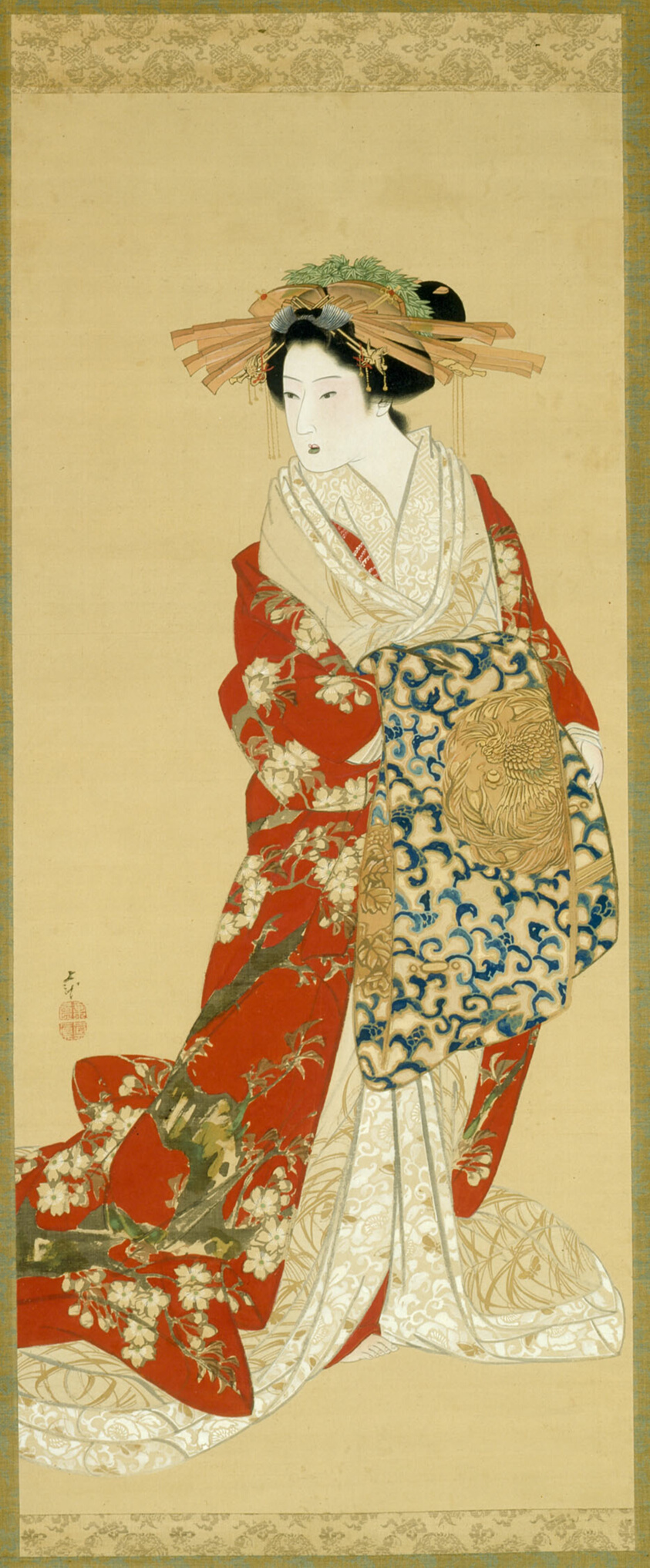
Heritage Artifact Analysis: The High Ranking Courtesan in Ink, Color, and Gold on Silk
Introduction: The Intersection of Craft and Status
Within the hallowed corridors of Lauren Fashion Heritage Lab, we examine a singular artifact that embodies the zenith of silk craftsmanship and the nuanced social stratigraphy of its era. This piece—a depiction of a high-ranking courtesan rendered in ink, color, and gold on silk—transcends mere portraiture. It serves as a testament to the materiality of power, the fluidity of elegance, and the silent language of luxury that defined a sophisticated class of women who wielded influence through artistry, intellect, and presence. The medium itself is not incidental; it is foundational. Silk, as a substrate, demands reverence, and the application of gold leaf and pigment upon it represents a deliberate elevation of subject and technique alike.
The courtesan, in this context, is not a marginal figure but a central arbiter of taste. Her representation on silk—a material historically reserved for the elite—mirrors the Savile Row ethos: impeccable construction, bespoke detailing, and an unspoken code of refinement. To understand this artifact is to decode the interplay between materiality and identity, where every brushstroke and gilded accent speaks to a heritage of meticulous labor and aesthetic ambition.
Materiality: Silk as a Canvas of Prestige
Silk is not merely a fabric; it is a narrative of trade, technology, and tradition. In this artifact, the silk ground is a finely woven habutai, characterized by its lustrous sheen and supple drape. The choice of silk for a courtesan’s portrait is deliberate: it mirrors her own attire, often composed of layered silks that signified wealth and social currency. The material’s ability to absorb and reflect light creates a dynamic surface, where the ink and pigments appear to float rather than rest. This optical illusion—a hallmark of classic silk craftsmanship—lends the courtesan an ethereal quality, as if she exists in a liminal space between the tangible and the ideal.
The application of ink and color on silk requires a mastery of tension and absorption. Unlike paper, silk is porous and unpredictable; the artist must work with the grain, allowing the medium to bleed and settle in controlled gestures. Here, the ink outlines are precise yet fluid, delineating the courtesan’s silhouette with a calligraphic grace that echoes the elegance of her posture. The colors—vermilion, indigo, and ochre—are derived from mineral and organic sources, their vibrancy preserved by the silk’s natural oils. Gold, applied as leaf or powder, accentuates her hair ornaments, the folds of her robe, and the subtle contours of her fan. This gilding is not ostentatious; it is restrained, applied in thin, deliberate strokes that catch the light like whispers of opulence.
Context: The Courtesan as Cultural Icon
To contextualize this artifact, we must consider the courtesan’s role as a cultural icon within her society. She was a figure of cultivated refinement—trained in music, poetry, and conversation—whose presence was sought after by the elite for her ability to elevate social gatherings. Her depiction on silk, a material associated with ceremonial and luxury goods, reinforces her status as a living artifact of taste. The fluid elegance of the composition—her tilted head, the gentle curve of her hand, the fall of her robe—mirrors the principles of Savile Row tailoring: balance, proportion, and an effortless sense of line.
This artifact also reflects the economic and artisanal ecosystems of its time. The production of such a piece required collaboration between the silk weaver, the pigment maker, and the artist, each a specialist in their craft. The gold leaf, for instance, was hand-beaten to gossamer thinness, a process that demanded patience and precision. The ink was ground daily to ensure freshness, while the silk was stretched and sized to prevent warping. This chain of expertise underscores the artifact’s value as a composite of human skill—a value that resonates with the bespoke traditions of London’s tailoring houses, where a single garment may involve dozens of artisans.
Symbolism and Aesthetic Language
The courtesan’s attire within the painting is itself a study in symbolic language. Her outer robe, likely a kosode or similar garment, is adorned with motifs of cherry blossoms and flowing water—emblems of transience and grace. The gold accents on her obi and hairpins signify not just wealth but a mastery of restraint; too much gold would overwhelm the composition, while too little would diminish her presence. This balance echoes the Savile Row principle of “quiet luxury,” where quality speaks through subtlety rather than display.
The ink outlines, meanwhile, serve as a metaphor for the courtesan’s own duality. They are both defining and permeable, suggesting a persona that is constructed yet fluid. Her expression—serene, knowing, slightly aloof—invites interpretation but resists full disclosure. This ambiguity is intentional, aligning with the courtesan’s role as a keeper of secrets and a performer of intimacy. The silk ground, with its inherent luminosity, reinforces this sense of layered identity, as if the viewer is glimpsing a truth that is always partially veiled.
Preservation and Legacy
As a heritage artifact, this piece requires careful stewardship. Silk is vulnerable to light, humidity, and handling; the pigments and gold are equally fragile. Conservation efforts must balance preservation with accessibility, ensuring that future generations can study its material and cultural dimensions. The Lauren Fashion Heritage Lab approaches this with a methodology that combines scientific analysis—spectroscopy to identify pigments, microscopy to examine weave structure—with art historical interpretation. This dual lens allows us to understand not just what the artifact is, but what it meant to its creators and patrons.
The legacy of the high-ranking courtesan, as captured in this medium, endures as a testament to the power of materiality in shaping identity. Silk, ink, color, and gold are not passive elements; they are active agents in the construction of prestige. In this, the artifact aligns with the enduring values of London Savile Row: a commitment to craft, a respect for tradition, and an unwavering pursuit of elegance. To study it is to engage with a dialogue between past and present, where the fluidity of silk becomes a metaphor for the fluidity of status itself.
Conclusion: A Reflection on Craft and Culture
This heritage research artifact—the high-ranking courtesan in ink, color, and gold on silk—offers a window into a world where materiality and meaning are inseparable. It reminds us that luxury is not merely an accumulation of precious substances but a language of intention and skill. For the scholar, the curator, and the connoisseur, it stands as a benchmark of excellence, a piece where every element—from the weave of the silk to the gleam of the gold—has been considered with the rigor of a master tailor. In preserving and interpreting such artifacts, we honor not only the courtesan herself but the countless hands that brought her image to life, and the enduring heritage of silk as a canvas for human aspiration.