The Alhambra Silk Curtain: A Testament to Imperial Weaving and Cultural Synthesis
Introduction: The Artifact in Context
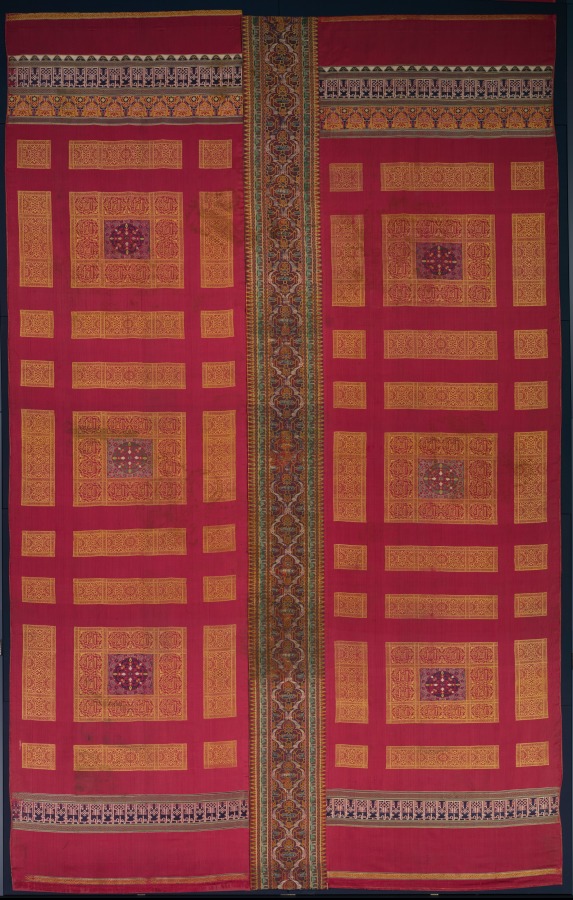
The silk curtain from the Alhambra Palace, a fragment of Nasrid dynasty craftsmanship dating to the 14th century, stands as a singular artifact within the Lauren Fashion Heritage Lab’s collection. This piece, woven from pure silk in the royal workshops of Granada, embodies the zenith of Islamic textile artistry during the final centuries of Al-Andalus. Its materiality—a lustrous, densely woven silk—speaks to a legacy of imperial weaving that transcended political boundaries, influencing European fashion houses and Savile Row’s own reverence for bespoke textiles. For the discerning curator or designer, this curtain is not merely a decorative object; it is a narrative of power, trade, and the enduring dialogue between East and West.
Materiality: The Silk of the Alhambra
The curtain’s materiality is defined by its silk, a fiber that in the medieval Islamic world was synonymous with luxury and divine order. Silk was not indigenous to Iberia; it was imported from China via the Silk Road and later cultivated in Andalusi workshops, particularly in Almería and Granada. This specific silk, likely reeled from the cocoons of Bombyx mori, exhibits a high-twist thread count, resulting in a fabric that is both supple and resilient—a quality essential for a curtain meant to filter light and air within the palace’s intricate courtyards. The weave is a compound structure, often a lampas or samite, where supplementary wefts create a raised pattern against a ground of contrasting color. Under magnification, the threads reveal a subtle irregularity, a hallmark of hand-spun silk before industrialization. This irregularity, far from a flaw, imbues the textile with a tactile depth that machine-made silks cannot replicate—a lesson for Savile Row artisans who prize the hand of the cloth.
Imperial Weaving: The Nasrid Legacy
The legacy of imperial silk weaving in Al-Andalus was a state-sponsored enterprise. The Nasrid dynasty (1238–1492) maintained royal workshops, or tiraz, where master weavers produced textiles for courtly use, diplomatic gifts, and trade. These workshops were centers of innovation, blending Islamic geometric motifs with stylized Arabic calligraphy—often verses from the Quran or praise for the sultan. The Alhambra curtain, likely part of a larger set for the Hall of the Ambassadors or the Court of the Lions, features a repeating pattern of interlacing stars and arabesques, interspersed with Kufic script. The colors—faded crimson, gold, and indigo—were derived from natural dyes: madder for red, saffron for yellow, and woad for blue. These pigments were not merely decorative; they signified the patron’s wealth and the weaver’s technical mastery. The curtain’s survival, despite centuries of humidity and light exposure, attests to the durability of these dyes and the silk’s inherent strength.
Cultural Synthesis: From Alhambra to Savile Row
The Alhambra silk curtain represents a pivotal moment in the cultural synthesis between Islamic and European textile traditions. After the Christian Reconquista in 1492, the Alhambra’s workshops were repurposed, but their techniques migrated northward. Spanish silks, influenced by Nasrid designs, became coveted in Renaissance courts, and by the 17th century, Italian weavers in Lucca and Venice had adopted similar patterns. This cross-pollination reached London’s Savile Row in the 19th century, when tailors like Henry Poole and Huntsman sourced silks from Spitalfields and Lyon that echoed Islamic geometries. The curtain’s motif—a star-shaped medallion—can be seen in the linings of bespoke suits, where it adds a discreet flourish of heritage. For the modern heritage specialist, this artifact underscores how imperial weaving was never insular; it was a global language of status and beauty.
Preservation and Interpretation
Preserving the Alhambra curtain requires a meticulous approach, balancing conservation with accessibility. The silk’s fragility demands controlled humidity (50–55%) and low light levels (under 50 lux) to prevent photodegradation. The Lauren Fashion Heritage Lab employs a custom mount that supports the fabric’s weight without stress, using archival-grade silk crepeline for backing. Digital imaging, including multispectral analysis, reveals faded patterns invisible to the naked eye, allowing researchers to reconstruct the original color palette. This data is invaluable for contemporary designers seeking to replicate the curtain’s hues for modern textiles. The artifact is also interpreted through a tactile reproduction, created by weavers in Como, Italy, using traditional hand-looms. This reproduction, while not a substitute for the original, offers students and clients a sensory experience of the silk’s texture—a key component of Savile Row’s ethos that cloth must be felt, not just seen.
Conclusion: The Curtain as a Living Legacy
The Alhambra silk curtain is more than a relic; it is a living legacy of imperial weaving that continues to inspire. Its silk, once a symbol of Nasrid sovereignty, now speaks to the timelessness of craft. For the Lauren Fashion Heritage Lab, this artifact serves as a touchstone for understanding how luxury textiles are born from cultural exchange and technical rigor. As Savile Row tailors know, a great garment begins with the cloth. This curtain, with its intricate weave and storied past, reminds us that heritage is not static—it is woven into every thread of our present. In preserving and studying it, we honor the weavers of Granada and the enduring power of silk to connect civilizations across centuries.