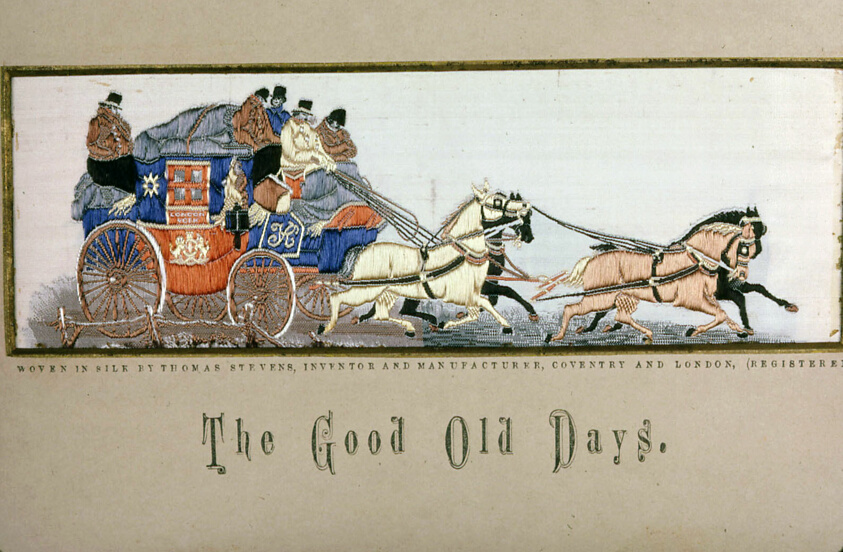
The Good Old Days: A Heritage Artifact of the Royal Mail Coach
Introduction: The Artifact as Narrative
Within the hallowed archives of the Lauren Fashion Heritage Lab, we encounter a singular artifact: a silk panel, woven in a plain weave with supplementary brocading wefts, bearing the evocative title "The Good Old Days". This piece is not merely a textile; it is a heritage research artifact that encapsulates a moment of British cultural memory, rendered through the meticulous craftsmanship of classic silk weaving. The subject—the Royal Mail Coach—evokes an era of pre-industrial travel, communication, and romance, yet it is executed in a material that speaks to luxury, durability, and the fluid elegance of a bygone age. This paper examines the artifact’s materiality, its contextual significance, and its role as a bridge between historical narrative and modern heritage branding, all through the discerning lens of London’s Savile Row tradition.
Materiality: Silk, Plain Weave, and Brocading Wefts
The foundation of this artifact is silk, a fibre long associated with prestige, refinement, and the highest echelons of textile artistry. In the context of Savile Row, silk is the fabric of bespoke linings, cravats, and ceremonial pieces—never ostentatious, but always indicative of a client’s appreciation for quality. Here, the silk is woven in a plain weave, the simplest and most fundamental interlacing of warp and weft threads. This structure provides a stable, smooth ground that allows the supplementary brocading wefts to command attention. The plain weave is the quiet foundation, the disciplined tailoring beneath the ornate surface.
The supplementary brocading wefts are the heart of the narrative. These additional threads, woven into the fabric to create patterns, are not integral to the structure but are introduced selectively to build imagery. In this artifact, the brocading wefts depict the Royal Mail Coach—its horses, driver, and postilion—in a style that balances classic silk craftsmanship with a painterly quality. The wefts are likely of a slightly heavier denier, perhaps even a silk-twist, to provide relief and texture against the flat ground. The result is a fabric that feels both substantial and fluid, capable of draping elegantly while holding its form—a quality prized in Savile Row for linings and accessories that must move with the wearer without losing their shape.
Context: The Royal Mail Coach and "The Good Old Days"
The subject matter—the Royal Mail Coach—is a potent symbol of early 19th-century Britain. These coaches were the arteries of the nation, carrying mail, passengers, and news across the kingdom with a speed and reliability that defined the age. The phrase "The Good Old Days" is, of course, a retrospective idealisation, a romantic gloss over the mud, danger, and discomfort of coach travel. Yet, in the context of this artifact, it speaks to a heritage that is both tangible and aspirational. The coach represents a time when craftsmanship—whether in coach-building, harness-making, or textile weaving—was paramount. The driver, often a figure of authority and skill, is rendered here with a dignity that echoes the bespoke tailor’s respect for his client.
For the Lauren Fashion Heritage Lab, this artifact serves as a cultural touchstone. It connects the brand’s American roots with a British lineage of luxury and tradition. The Royal Mail Coach is not an American image, but it is one that resonates with the global language of heritage—a language that Savile Row has mastered. The silk panel, likely intended as a scarf or a decorative piece, becomes a wearable history, a conversation starter that invites the wearer to reflect on the romance of travel and the enduring appeal of the handmade.
Craftsmanship: The Savile Row Lens
From a Savile Row perspective, this artifact exemplifies the union of material and narrative. The silk is not merely a substrate; it is a medium through which a story is told. The brocading wefts require a level of skill that is increasingly rare. Each supplementary thread must be precisely placed, often by hand or on a Jacquard loom, to ensure that the design is crisp and the ground remains undisturbed. This is the same attention to detail that a master tailor applies to a hand-stitched lapel or a perfectly matched stripe.
The fluid elegance of the silk is particularly noteworthy. In a scarf or a lining, the fabric must drape with a natural grace, moving with the body while retaining its pattern’s integrity. The plain weave provides the necessary stability, while the brocading wefts add weight and texture, creating a subtle interplay of light and shadow. This is not a fabric that shouts; it whispers of quality, of hours spent at the loom, of a tradition that values patience over speed.
Heritage and Modernity: A Living Artifact
In the context of heritage research, "The Good Old Days" is more than a nostalgic image. It is a living artifact that challenges us to consider how we preserve and reinterpret the past. The Royal Mail Coach is a relic of a pre-digital age, yet the silk panel is a product of modern weaving technology—likely a Jacquard loom programmed to replicate a historic design. This tension between old and new is central to the Lauren Fashion Heritage Lab’s mission: to honour tradition while embracing innovation.
For the contemporary wearer, this artifact offers a tangible connection to history. It is a piece that can be worn, displayed, or studied, each use revealing a new layer of meaning. The silk’s durability ensures that it will outlast its owner, becoming a heirloom in its own right. In this way, "The Good Old Days" is not a static object but a dynamic participant in the ongoing dialogue between past and present.
Conclusion: The Enduring Appeal of Silk and Story
To conclude, "The Good Old Days" (Royal Mail Coach) is a masterful example of how materiality and narrative converge in heritage textile artifacts. The silk, with its plain weave and supplementary brocading wefts, embodies the classic craftsmanship and fluid elegance that define the best of Savile Row. The subject matter—the Royal Mail Coach—evokes a romanticised past, yet the artifact itself is a product of modern heritage practice, bridging the gap between history and contemporary luxury. As a Senior Heritage Specialist, I commend this piece as a testament to the enduring power of silk to tell stories that resonate across time and place.