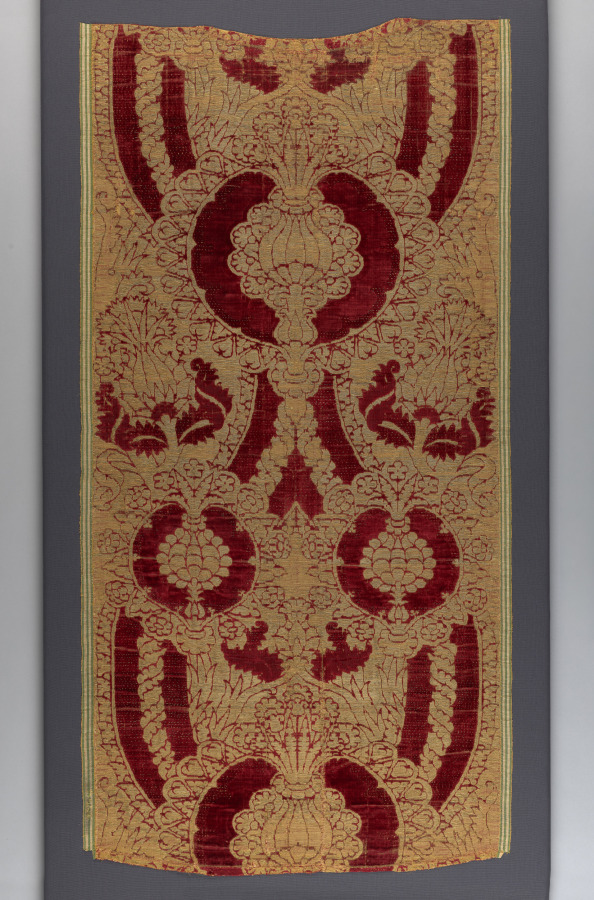
The Pomegranate in Silk and Gold: A Heritage Artifact of Imperial Weaving
In the hushed ateliers of Savile Row, where precision meets artistry, the legacy of imperial silk weaving endures as a testament to material mastery. Among the most evocative artifacts in the Lauren Fashion Heritage Lab is a fragment of silk velvet with gold in pomegranate pattern, a textile that bridges the opulence of ancient courts with the disciplined craft of modern luxury. This artifact, dating from the 16th to 17th century Safavid or Ottoman empires, is not merely a fabric; it is a narrative woven in thread and metal, embodying the pinnacle of silk technology and the symbolic power of nature in imperial iconography.
The materiality of this piece is its first and most commanding statement. The base is silk velvet, a fabric that demands extraordinary skill to produce. Velvet, from the Latin vellus (fleece), is created by weaving a supplementary warp that is cut to form a dense, plush pile. In imperial contexts, this was achieved through a complex drawloom mechanism, requiring two weavers—one to operate the pedals, another to manipulate the pattern harness. The result is a surface that absorbs and reflects light with a depth unmatched by flat weaves. Here, the velvet is not uniform; the pile is selectively cut and uncut, creating a chiaroscuro effect that animates the pomegranate motif. The ground weave, a silk satin or twill, provides a lustrous counterpoint to the matte pile, a dialogue of textures that speaks to the weaver’s command of tension and fiber.
The gold element elevates this artifact from textile to treasure. Gold thread, or metal-wrapped silk, was a hallmark of imperial patronage. In this piece, the gold is not a flat foil but a fine strip of beaten gold wound around a silk core, often with a gilded silver or copper substrate to reduce weight and cost while preserving brilliance. The thread is brocaded into the fabric—introduced as a supplementary weft that floats on the surface, secured only where the pattern demands. This technique, known as lampas or brocaded velvet, allowed for intricate, metallic details without compromising the velvet’s pliability. The gold appears in the pomegranate’s seeds and the stylized leaves, catching light as the fabric moves, a shimmer that once signified the divine right of rulers in Safavid Persia or Ottoman Turkey.
The Pomegranate Motif: Symbolism and Structure
The pomegranate pattern is no mere decoration; it is a coded emblem of fertility, immortality, and sovereignty. In Persian and Islamic art, the pomegranate (Punica granatum) is a symbol of abundance and the cycle of life, often associated with paradise gardens. In this artifact, the fruit is rendered in a stylized, symmetrical form—a central oval with a crown-like calyx, surrounded by curling leaves and vines. The pattern repeats in a mirror-reverse or boteh-like arrangement, a common device in imperial silks to create a sense of infinite regress. The gold seeds are not random; they are arranged in concentric circles or diamond grids, echoing the geometric precision of Islamic tessellation. This structure is not merely aesthetic; it reflects the mathematical rigor of court workshops, where patterns were codified in pattern books and transferred to the loom via punched cards—a precursor to the Jacquard system.
The color palette is restrained yet potent. The velvet pile is a deep crimson or madder red, achieved through kermes or cochineal dyes, which were among the most expensive in the pre-modern world. Red symbolized power, passion, and the blood of martyrs in both Persian and Christian contexts, making it a favored color for royal robes and religious vestments. The gold thread adds a third dimension—a warm, reflective yellow that contrasts with the red’s depth. This chromatic tension is deliberate: the red grounds the pattern, while the gold lifts it, creating a visual hierarchy that draws the eye to the pomegranate’s core. The absence of blue or green suggests a focus on primary, elemental forces, aligning with the artifact’s likely use in ceremonial contexts—perhaps as a sash, cushion cover, or robe lining for a Safavid shah or Ottoman sultan.
Imperial Silk Weaving: A Legacy of Craft and Power
The context of this artifact is the imperial silk workshop, or karkhana, a state-run institution that controlled every aspect of production, from silkworm rearing to loom construction. In Safavid Iran (1501–1736), the royal workshops in Isfahan produced silks for the court, diplomatic gifts, and the lucrative export trade to Europe. Similarly, the Ottoman imperial factories in Bursa and Istanbul wove silks for the sultan’s wardrobe, mosque furnishings, and military banners. This system ensured quality control and technical innovation; the pomegranate velvet, for instance, required a loom with at least two warp beams—one for the ground, one for the pile—and a third for the gold weft. The weaver’s skill was measured by the evenness of the pile and the precision of the pattern registration, which could take months to complete for a single piece.
The legacy of this weaving tradition is directly relevant to Savile Row’s ethos. Just as a bespoke suit is a collaboration between cutter and client, imperial silk was a dialogue between weaver and patron. The pomegranate pattern, with its balance of symmetry and organic form, prefigures the geometric motifs of modern luxury—think of the subtle pinstripes or houndstooth checks that define a Huntsman or Anderson & Sheppard jacket. The gold thread, too, finds its echo in the metallic buttons or silk linings of a Gieves & Hawkes evening coat. The artifact reminds us that heritage is not static; it is a living language of materials and techniques that evolves with each generation of craftsmen.
Preservation and Interpretation
In the Lauren Fashion Heritage Lab, this artifact is stored in a climate-controlled environment at 50% relative humidity and 18°C, with UV-filtered lighting to prevent dye fading and silk degradation. The gold thread is particularly vulnerable to tarnish from sulfur in the air, so the piece is sealed in an archival polyester sleeve with a desiccant pack. Our conservators have documented the weave structure via digital microscopy, revealing a pile height of 2.5 mm and a gold thread diameter of 0.3 mm. This data is critical for future restoration or reproduction, should a Savile Row house wish to commission a modern iteration—a scarf, a waistcoat, or a lining that channels the same imperial grandeur.
To interpret this artifact for a contemporary audience, we consider its resonance with the Lauren aesthetic: a fusion of timeless elegance and narrative depth. The pomegranate, with its seeds of gold, speaks to the idea of hidden luxury—details that reward close observation. This is the essence of Savile Row tailoring, where a hand-stitched buttonhole or a pick-stitched lapel reveals the wearer’s discernment. The silk velvet with gold is not a relic; it is a benchmark for quality, a reminder that true heritage lies in the marriage of material and meaning. As we study its threads, we are not merely analyzing a textile; we are decoding a language of power, beauty, and human ingenuity that continues to shape the finest garments in the world.