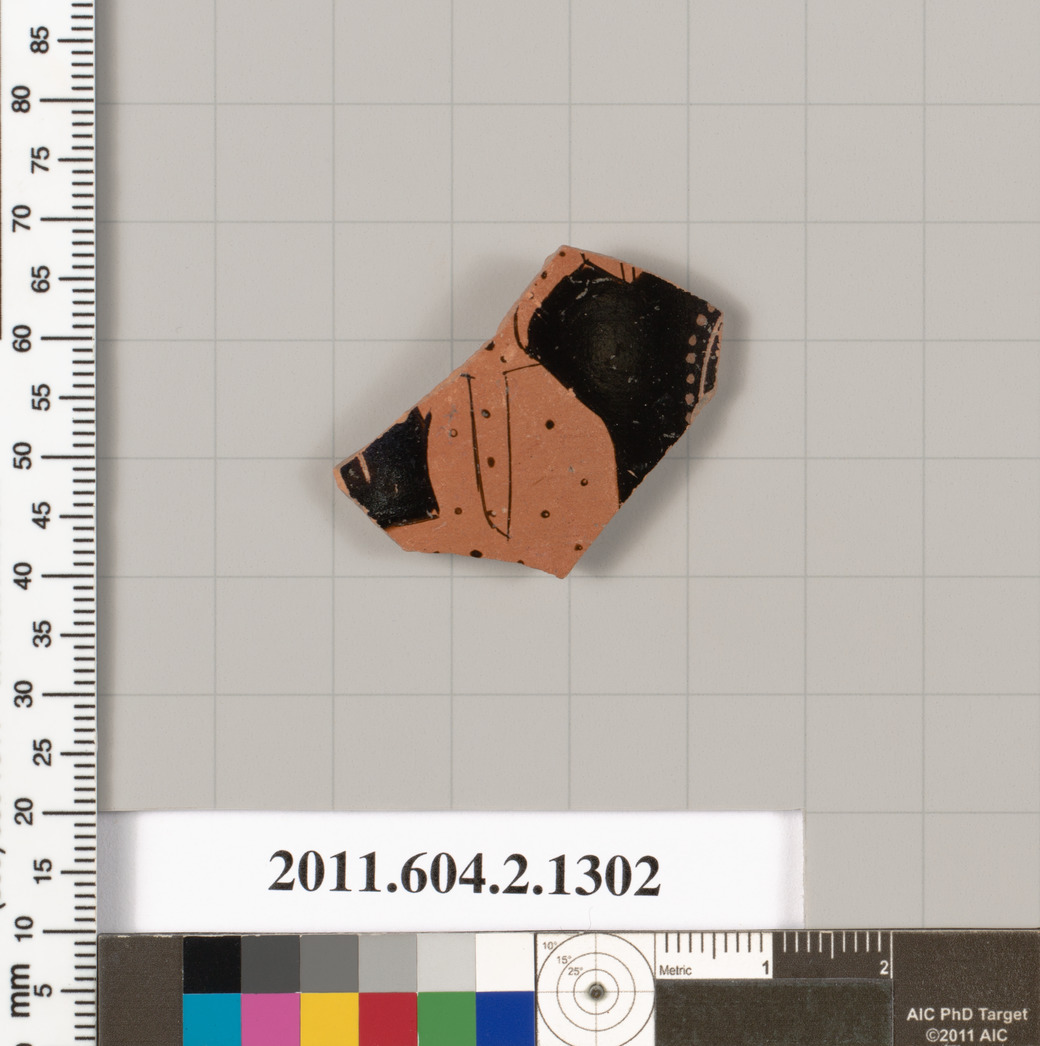
The Dialectic of Patina: Terracotta Fragment, Temporal Depth, and the 2026 Old Money Silhouette
The conceptualization of “Old Money” aesthetics in contemporary fashion often risks a superficial historicism, mistaking the mere quotation of past forms for the embodiment of inherited, time-tested value. To move beyond this, the Lauren Fashion Heritage Lab proposes a deeper philosophical and material engagement with time itself. Our internal genetic code, centered on the Eastern dialectic of dynamic movement and eternal stillness as seen in the Musician-Patterned Pottery Mold Fragment and the Arhat Paintings, finds a profound Western correlative in the Terracotta fragment of a skyphos (Attic, Greek). This artifact does not merely inform 2026 Old Money silhouettes through literal motif; it provides a master theory of patina as structural principle, guiding a shift from displaying wealth to exhibiting temporal intelligence.
From Fragment to Form: The Architecture of Incompleteness
The Attic skyphos fragment is, by its very nature, a testament to both presence and absence. Its curved form hints at the original vessel’s volume—a container for symposium wine and discourse—while its fractured edges speak of rupture, burial, and rediscovery. This state of dignified incompleteness directly challenges the 2026 Old Money silhouette’s relationship with “finish.” We propose moving away from the immaculately tailored, aggressively complete suit of arms. Instead, the silhouette will embrace a strategic architectural fragmentation. This manifests in deconstructed blazers where the internal canvas and seam allowances become a deliberate, aesthetic feature—not as punk rebellion, but as scholarly revelation of a garment’s “archaeology.” A coat’s hem may appear gently eroded or asymmetrically layered, echoing the skyphos fragment’s broken edge, suggesting it has weathered seasons of use rather than just emerged from an atelier. The silhouette is not broken; it is curated to show evidence of a narrative.
The Patina of Surface: Terracotta’s Material Memory
The terracotta’s surface is its archive. The faint traces of slip, the oxidation marks from firing, the earthy pigment altered by millennia in the Attic soil—each layer is a text. This informs a radical approach to fabric and dye in 2026. Old Money is no longer synonymous with pristine wool or unchanging navy. It evolves into an aesthetic of stratified coloration and textured memory. We will develop exclusive fabrics—heritage-black wools, deep charcoal cashmeres—that undergo proprietary finishing processes to embed a sense of temporal depth. Techniques derived from ceramic aging, such as subsurface dyeing (where the base hue is over-dyed with a translucent wash, allowing the under-layer to glow through like terracotta under a glaze) and mineral deposition (applying microscopic mineral pigments that settle into the fabric’s weave, mimicking geological accretion), will create garments that appear to have absorbed light and history. The color “Heritage-Black” itself becomes not a flat void, but a rich, complex stratum, holding whispers of midnight blue, forest green, or earth umber within its depths.
The Silhouette of the Symposium: Contained Ease and Intellectual Volume
The original skyphos was a vessel for communal exchange, designed to be held, passed, and used in dynamic social ritual. Its form—deep, capacious, with horizontal handles—suggests a container built for both utility and graceful interaction. This translates to the 2026 Old Money silhouette through a philosophy of contained volume and intellectual ease. We move beyond the restrictive, power-shouldered suit. Instead, tailoring embraces a moderated, ergonomic drape. Jackets exhibit a slight, thoughtful fullness across the back and sleeves, creating a sense of mental and physical spaciousness—room for thought, for gesture, for the breath of conversation. This is not oversized fashion; it is calibrated volume, echoing the skyphos’s ability to hold liquid. Trousers favor a gentle, continuous line from a relaxed waist to a clean break, suggesting uninterrupted motion. The handles of the cup find their echo in the strategic placement of functional details: a precisely angled pocket, a toggle closure on a coat that invites the hand, a sleeve placket that rolls back to reveal a contrasting inner layer—all designed for engaged, tactile living.
The Eternal Present: Synthesizing Movement and Stillness
Finally, the terracotta fragment synthesizes our internal genetic code. Like the Musician-Patterned Fragment, it captures a moment—the act of the drink, the symposium’s lively discourse—frozen in fired clay. Like the Arhat Paintings, it now exists in a state of contemplative stillness, an object of quiet study. The 2026 Old Money silhouette must embody this same synthesis: the dynamic ease of movement in the present moment, crystallized into a form that speaks of permanent value. A coat that flows with the wearer’s stride (the dynamic) yet retains an immutable, sculptural line when at rest (the eternal). A garment that feels intuitively modern in its wearability yet resonates with the deep, material memory of ancient artifacts. It is fashion not as costume, but as cultivated artifact—designed to be used, appreciated, and eventually, to acquire its own authentic narrative patina.
Thus, the Terracotta Fragment teaches us that true Old Money elegance for 2026 is an archaeology of the present. It is a silhouette built on the intelligence of time, wearing its history—both imagined and real—in its very structure, surface, and spirit. It is not about looking old, but about embodying depth, where every line and texture whispers of a continuum between the symposium of yesterday and the cultivated life of today.