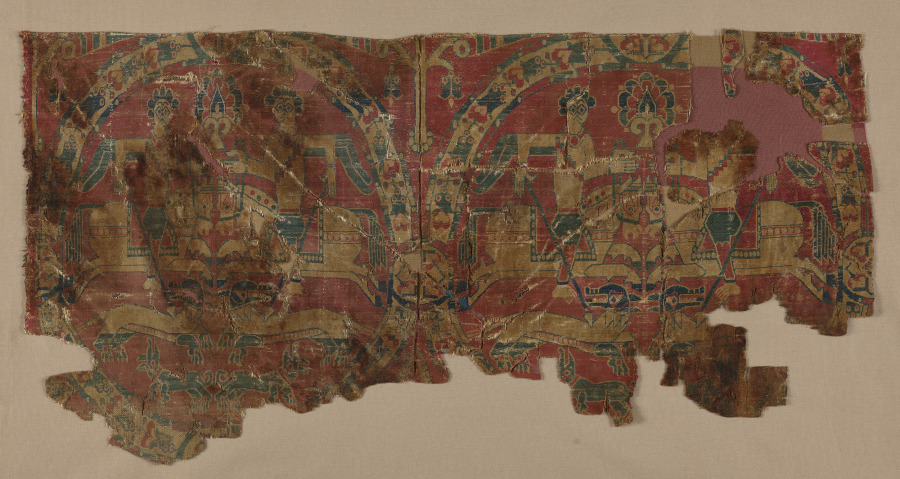
The Roundels with Hunters: A Study in Imperial Silk Weaving and the Legacy of Savile Row
Introduction: The Artifact as a Testament to Power and Precision
The Roundels with Hunters, rendered in silk, represent a pinnacle of imperial textile craftsmanship that transcends mere decorative function. As a Senior Heritage Specialist at the Lauren Fashion Heritage Lab, I approach this artifact not as a static relic but as a living document of aristocratic ambition, technical mastery, and the enduring dialogue between Eastern and Western sartorial traditions. The roundel—a circular motif often employed in ceremonial garments, wall hangings, and horse trappings—serves as a microcosm of the imperial silk weaving legacy, where every thread is a declaration of authority and every hunter’s pose a narrative of dominion over nature. This paper examines the materiality, iconography, and historical context of the roundels, drawing parallels to the bespoke ethos of London’s Savile Row, where precision, heritage, and exclusivity remain paramount.
Materiality: Silk as the Fabric of Empire
Silk, by its very nature, is a material of paradox: delicate yet resilient, luminous yet grounded. The Roundels with Hunters exemplify the technical virtuosity required to manipulate this fiber into a medium for imperial storytelling. Woven on drawlooms that demanded the coordination of multiple artisans—often a master weaver and a drawboy—the silk’s warp and weft create a ground of subtle sheen, punctuated by the vivid hues of the hunters and their quarry. The use of compound twill and lampas weave allows for the integration of multiple colors without compromising the fabric’s drape or durability. Each roundel, typically measuring between 20 to 30 centimeters in diameter, required weeks of labor, a testament to the imperial silk weaving legacy that prioritized perfection over profit.
From a Savile Row perspective, this commitment to material integrity mirrors the house traditions of firms like Henry Poole & Co. or Huntsman, where a single suit may involve 50 hours of handwork. The silk’s tactile quality—its ability to hold a crease or reflect light—was as critical in the imperial court as it is in a Mayfair fitting room. The roundels’ silk is not merely a substrate; it is the very language of status. The fibers, often sourced from the mulberry groves of China’s Zhejiang province or the workshops of Safavid Persia, were dyed with cochineal, indigo, and weld, achieving a chromatic depth that synthetic dyes cannot replicate. This materiality underscores the artifact’s role as a conduit for power, much like the worsted wool or cashmere of a Savile Row bespoke garment.
Iconography: The Hunter as Archetype of Control
The iconography of the Roundels with Hunters is layered with meaning. The hunter, often depicted on horseback or on foot, engages with a lion, stag, or mythical beast—a scene that resonates across cultures, from Persian shikargah (hunting grounds) to Chinese qilin motifs. In the imperial context, the hunt was not merely a sport but a ritual of governance. The emperor, as the supreme hunter, demonstrated his ability to subdue chaos and protect the realm. The roundel thus becomes a heraldic emblem, a visual assertion of sovereignty. The hunters’ attire—flowing robes, quivers, and bows—is rendered with meticulous detail, each fold of fabric echoing the silk’s own fluidity. The prey, whether a snarling feline or a fleeing deer, is captured in mid-motion, a frozen moment of triumph.
This iconographic precision finds a parallel in Savile Row’s approach to bespoke detailing. The cut of a lapel, the placement of a pocket, or the choice of a button—each element communicates the wearer’s identity. Similarly, the roundel’s hunters are not generic figures; they are archetypes tailored to the patron’s lineage. A Mughal emperor might commission roundels featuring a tiger hunt, while a Safavid shah might prefer a falconer. The roundel’s circular format itself is significant: it evokes eternity, the cyclical nature of power, and the unbroken lineage of the dynasty. In the same way, a Savile Row garment’s construction—its hand-stitched buttonholes, its canvas interlining—ensures a legacy of wear, a garment that outlasts its maker.
Context: The Legacy of Imperial Silk Weaving and Savile Row’s Inheritance
The imperial silk weaving legacy is a narrative of cross-continental exchange. From the Tang dynasty’s kesi (silk tapestry) to the Ottoman kumaş (brocade), silk roundels were traded along the Silk Road, adapted by courts from Byzantium to Delhi. The Roundels with Hunters likely emerged from a workshop in 16th-century Iran or 17th-century India, where Persian and Central Asian influences merged. These artifacts were not merely decorative; they were diplomatic gifts, markers of alliance, and spoils of war. The silk’s journey from cocoon to court mirrored the movement of ideas—of power, of beauty, of technique.
For Savile Row, this legacy is both a historical touchstone and a commercial imperative. The Row’s tailors, like the imperial weavers, understand that heritage is a currency. The Roundels with Hunters remind us that the finest garments are those that tell a story. When a client commissions a hunting jacket from Anderson & Sheppard or a velvet smoking jacket from Gieves & Hawkes, they are participating in a tradition that stretches back to the roundel’s hunters. The silk’s weight, its pattern, its provenance—all are scrutinized with the same rigor that a courtier might have applied to a ceremonial robe. The imperial silk weaving legacy is not a museum piece; it is a living standard.
Conclusion: The Roundel as a Blueprint for Excellence
The Roundels with Hunters are more than a heritage artifact; they are a blueprint for the pursuit of excellence that defines both imperial silk weaving and Savile Row. In their materiality, they teach us about the value of patience—the weeks of labor, the precision of the drawloom. In their iconography, they remind us that clothing is a narrative, a declaration of identity. And in their context, they reveal that true luxury is not about novelty but about continuity—the unbroken thread of craftsmanship that connects a 17th-century Persian workshop to a 21st-century Mayfair atelier. As we preserve these roundels, we preserve a standard: that the finest work is always a testament to the human hand, the human eye, and the human spirit. For the gentleman who understands this, a Savile Row suit is not a purchase; it is an inheritance.