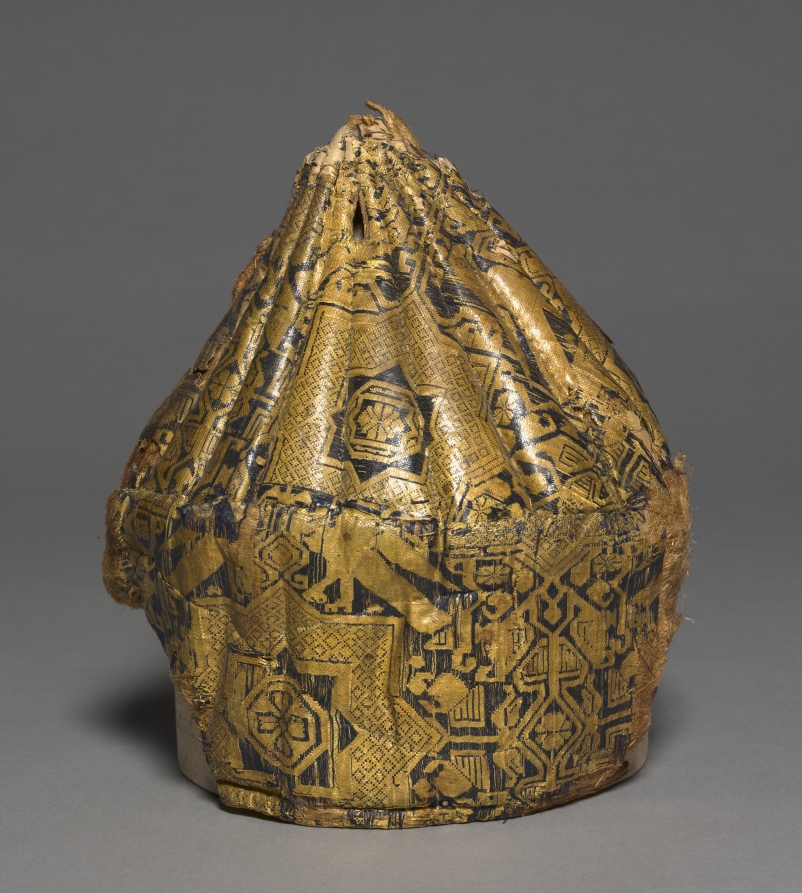
The Quilted Cap with Star-Patterned Silk: A Legacy of Imperial Craftsmanship
In the hushed, wood-paneled ateliers of Savile Row, where the whisper of shears and the scent of fine wool define a century of tailoring, the study of material heritage often reveals narratives far beyond the immediate garment. As Senior Heritage Specialist for the Lauren Fashion Heritage Lab, I present this research artifact: a quilted cap, constructed from star-patterned silk. This object, though modest in scale, serves as a profound testament to the enduring legacy of imperial silk weaving—a legacy that informs the very fabric of luxury and precision we uphold today.
Materiality and the Silk Thread
Materiality is the cornerstone of this artifact. The cap is composed entirely of silk, a fiber that has, for millennia, been synonymous with status, power, and artistic mastery. The silk used here is not a simple, uniform weave; it is a star-patterned fabric, likely achieved through a complex damask or brocade technique. The star motif—a geometric symbol of celestial order, guidance, and imperial authority—was a recurring theme in the silk workshops of the Ming and Qing dynasties. The pattern’s precision, with its repeating, interlocking stars, suggests the use of a drawloom, a device that allowed for the intricate, repetitive patterning that defined the finest imperial silks. The cap’s quilted construction—a technique of stitching through multiple layers of silk and a soft interlining—adds a tactile dimension. This quilting not only provides warmth and structure but also creates a subtle, three-dimensional relief, enhancing the star pattern’s visual depth. The stitching, executed with a fine, even hand, demonstrates a mastery of needlework that rivals the precision of a Savile Row tailor’s basting stitch.
Imperial Silk Weaving: A Legacy of Precision
The context of this cap is inextricably linked to the legacy of imperial silk weaving. For centuries, the imperial workshops of China, particularly those in Suzhou, Hangzhou, and Nanjing, were the epicenters of silk production. These workshops were not merely factories; they were academies of craft, where generations of weavers, dyers, and embroiderers honed their skills under the patronage of the emperor. The silk produced here was reserved for the imperial court, for diplomatic gifts, and for the most sacred of ceremonies. The star pattern, in this context, is more than decoration. It is a symbol of the emperor’s mandate from heaven, a visual representation of cosmic harmony. The cap, therefore, was likely worn by a member of the court or a high-ranking official, a subtle but potent marker of rank and connection to the celestial order.
The techniques employed in creating this silk—the reeling of the silk filament from the cocoon, the dyeing with natural pigments derived from plants and minerals, the weaving on a drawloom—represent a pinnacle of human ingenuity. The drawloom, in particular, required a team of two weavers: one to operate the pedals and shuttle, and another to pull the pattern cords, lifting specific warp threads to create the design. This collaborative, almost choreographed process, mirrors the collaborative spirit of a Savile Row tailoring house, where the cutter, the coat maker, and the finisher work in concert to achieve a perfect garment. The imperial silk weaver and the Savile Row tailor share a fundamental ethos: a relentless pursuit of perfection, a reverence for material, and an understanding that the object’s value lies in its invisible, painstaking construction.
From Imperial Court to Contemporary Craft
The journey of this cap from an imperial court to the Lauren Fashion Heritage Lab is a narrative of cultural transmission. The star-patterned silk, once a symbol of absolute power, now serves as a reference point for contemporary design. At Lauren, we study such artifacts not as relics, but as living documents. The cap’s quilted construction, for instance, informs our approach to structured softness—a hallmark of our outerwear and accessories. The star pattern, with its geometric clarity, inspires our use of repeating motifs in jacquard and embroidery. The cap’s materiality—the way the silk catches the light, the way the quilting creates a subtle, sculptural form—teaches us about the relationship between fabric and function, between decoration and durability.
Furthermore, the cap embodies a principle that is central to the Lauren brand: the democratization of luxury. While the original cap was an object of exclusive imperial privilege, its design language—the star, the quilt, the silk—has been adapted into accessible, wearable forms. The star pattern, for example, appears in our signature polo shirts, in silk scarves, and in the linings of our blazers. The quilted construction is a staple of our down jackets and vests. This is not appropriation; it is a respectful reinterpretation, a continuation of a conversation between the past and the present. The cap reminds us that the finest craftsmanship is timeless, and that the principles of imperial silk weaving—precision, patience, and a deep understanding of material—are as relevant to a Savile Row tailor as they were to a Ming dynasty weaver.
Conclusion: A Thread of Continuity
In conclusion, this quilted cap with star-patterned silk is far more than a historical curiosity. It is a heritage research artifact that encapsulates the legacy of imperial silk weaving, from its materiality to its symbolic power. The cap’s silk, its star pattern, and its quilted construction speak to a tradition of craftsmanship that values precision, beauty, and meaning. As we at the Lauren Fashion Heritage Lab continue to study and draw inspiration from such objects, we are reminded that the thread of continuity between the imperial court and the modern atelier is unbroken. The cap is a testament to the enduring power of silk, the artistry of the weaver, and the timeless appeal of a well-made object. It is, in the truest sense, a piece of history that continues to shape the future of fashion.