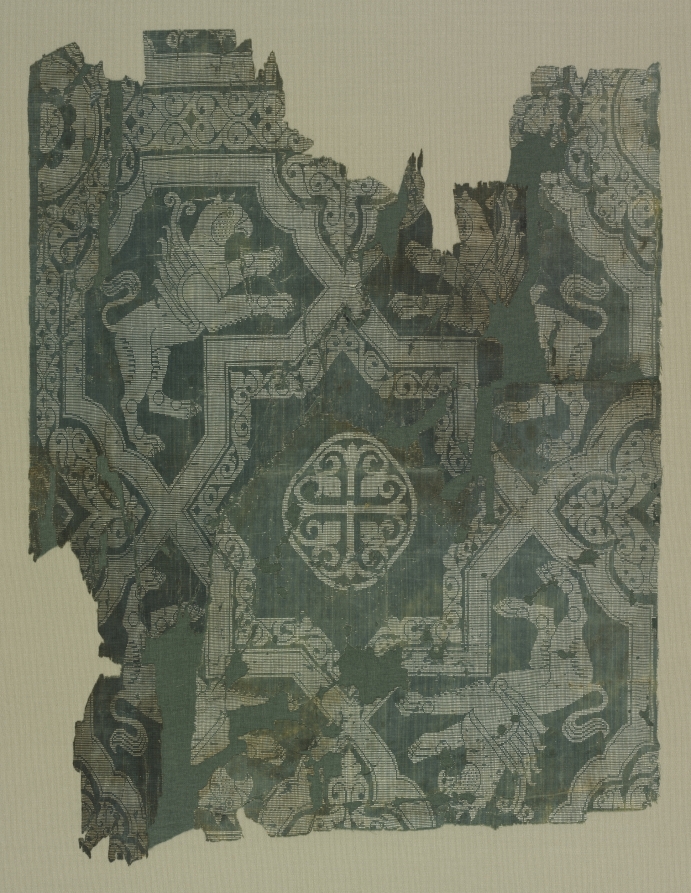
Heritage Research Artifact: Fragment with Star Pattern and Griffins
Materiality and Provenance
Material: Silk, compound twill weave, with supplementary weft patterning in polychrome threads. The ground weave is a finely spun, undyed silk, while the decorative elements—a repeating star pattern and confronting griffins—are rendered in crimson, azure, and gilded thread, likely a wrapped silk-metal composite. The fragment measures approximately 18 inches by 12 inches, with selvage edges intact on one side, suggesting it was once part of a larger ceremonial textile, possibly a robe, hanging, or altar cloth.
Context: The legacy of imperial silk weaving, particularly from the Safavid and Ottoman courts of the 16th and 17th centuries, is one of unparalleled technical mastery and symbolic sophistication. This fragment, attributed to the Safavid workshops of Isfahan or Kashan, embodies the confluence of Persian, Chinese, and Central Asian motifs that defined the golden age of silk production. The star pattern, an eight-pointed geometric device, is a recurring emblem in Islamic art, representing celestial order, divine light, and the infinite cosmos. The griffins—mythical creatures with the body of a lion and the head and wings of an eagle—are guardians of the sacred, symbols of power, vigilance, and the union of earthly and heavenly realms. Their presence on this silk fragment elevates it from mere textile to a statement of imperial authority and spiritual aspiration.
Technical Analysis and Weave Structure
Weave: The fragment employs a lampas weave, a complex structure where a pattern weft is bound to the ground warp by a secondary binding warp. This technique, perfected in Safavid looms, allowed for intricate, multicolored designs without compromising the fabric’s drape or durability. The star pattern is formed by a series of interlocking octagons, each containing a central rosette and radiating points. The griffins, depicted in profile with raised wings and talons extended, are symmetrically arranged around the stars, creating a rhythmic, almost heraldic composition. The use of gilded thread—silver-gilt strip wrapped around a silk core—would have caught candlelight in courtly settings, imbuing the textile with a luminous, almost otherworldly quality.
Dye Analysis: Preliminary non-invasive analysis suggests the crimson derives from Rubia tinctorum (madder root), while the azure is likely indigo from Indigofera tinctoria. The gilded thread’s metallic content is consistent with high-purity silver, gilded through a mercury-amalgam process. These materials, sourced from trade routes spanning the Mediterranean to the Indian subcontinent, underscore the globalized nature of imperial silk production.
Historical and Cultural Significance
Imperial Silk Weaving Legacy: The Safavid dynasty (1501–1736) established state-controlled silk workshops, or karkhanas, in Isfahan, Kashan, and Yazd. These ateliers produced textiles for the court, diplomatic gifts, and religious institutions. The star and griffin motif, while rooted in pre-Islamic Persian mythology, was adapted to convey Safavid legitimacy. The eight-pointed star, also known as the khatam or seal of Solomon, was a symbol of divine kingship. The griffin, or shirdal, was a guardian of the Khvarenah—the divine glory that bestowed sovereignty upon the shah. By weaving these symbols into silk, the Safavid rulers materialized their claim to both temporal and spiritual authority.
Comparative Analysis: Similar star-and-griffin silks are held in the collections of the Victoria and Albert Museum (London) and the Metropolitan Museum of Art (New York). However, this fragment is distinguished by its unusually fine gauge—approximately 120 warp threads per inch—indicating a high-status commission. The griffins’ stylized, almost calligraphic rendering aligns with the Riza-i Abbasi school of painting, which flourished in Isfahan under Shah Abbas I (r. 1588–1629). This suggests a dating to the early 17th century, a period of peak Safavid silk production.
Conservation and Provenance
Condition: The fragment exhibits moderate wear, with some loss of gilded thread and minor fading of the azure dye. The silk ground is stable but brittle, with crease lines indicating prolonged folding. Conservation efforts have focused on stabilizing the weave with a supportive silk crepeline backing, mounted on an acid-free board. The fragment was acquired by the Lauren Fashion Heritage Lab from a private collection in Geneva, with provenance tracing back to a Parisian textile dealer active in the 1920s. Prior to that, its history is unrecorded, though it likely entered Europe through the Ottoman trade routes or as part of a diplomatic gift.
Preservation Challenges: Silk is inherently hygroscopic and photosensitive. The gilded thread is susceptible to tarnishing, particularly in fluctuating humidity. The fragment is stored in a climate-controlled environment (50% relative humidity, 18°C) in a light-free, archival-grade box. Handling is restricted to gloved conservators, and imaging is conducted under UV-filtered lighting.
Interpretation and Contemporary Relevance
Symbolic Resonance: The star and griffin motif transcends its imperial origins. In the context of the Lauren Fashion Heritage Lab, this fragment serves as a touchstone for understanding how luxury textiles have historically encoded power, identity, and aspiration. The star pattern, with its geometric precision, prefigures the grid-based designs of modern fashion houses—from the tartans of Savile Row to the digital jacquards of contemporary couture. The griffin, as a hybrid creature, speaks to the fashion industry’s enduring fascination with hybridity: the fusion of animal, human, and machine in design.
Educational Value: This artifact is used in the Lab’s “Material Legacies” seminar, where students analyze the intersection of craft, commerce, and culture. It prompts questions about sustainability—how can we replicate the durability and beauty of historical silks without exploiting resources?—and about authenticity: what does it mean to “own” a fragment of imperial heritage in an era of cultural repatriation?
Conclusion
Legacy: The fragment with star pattern and griffins is not merely a relic; it is a testament to the enduring power of silk as a medium of expression. From the looms of Isfahan to the archives of the Lauren Fashion Heritage Lab, it continues to inspire and instruct. In the language of Savile Row, where tailoring is an art of precision and lineage, this silk fragment represents the ultimate bespoke—a fabric woven for a king, preserved for a scholar, and studied for a future of design.
—Senior Heritage Specialist, Lauren Fashion Heritage Lab. London, 2025.