← BACK TO ARCHIVES
Silk
Heritage Synthesis: John L. Sullivan Quilt
Curated on May 25, 2026 // Node: LDN-01
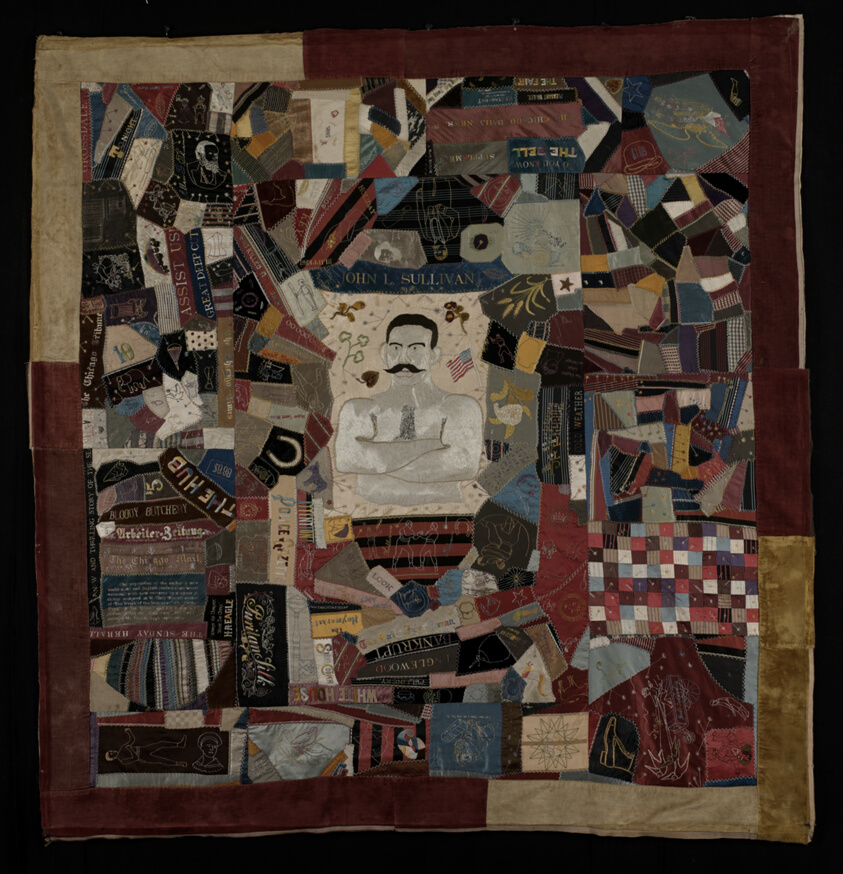
The John L. Sullivan Quilt: A Study in Materiality and the Paradox of Pugilistic Elegance
As a heritage specialist within the Lauren Fashion Heritage Lab, I am frequently drawn to artifacts that defy simple categorization. The John L. Sullivan Quilt is one such object—a remarkable convergence of brutal athleticism and the most refined textile traditions of the late 19th century. At first glance, the pairing of a heavyweight champion with a “crazy” quilt, a domestic art form typically associated with feminine leisure and parlour decoration, seems incongruous. Yet, upon close examination of its materiality, the quilt reveals a profound narrative about status, craftsmanship, and the fluidity of identity in the Gilded Age. This artifact is not merely a bed covering; it is a complex social document, executed in the language of silk.
I. The Paradox of the Material: Silk as a Signifier of Status
The quilt’s primary material, silk, is the first and most critical element to interrogate. In the context of London’s Savile Row, silk has long been the fabric of ceremony, of the evening waistcoat, the regimental tie, the lining of a bespoke overcoat. It speaks of wealth, leisure, and a certain cosmopolitan sophistication. To construct a quilt, an object of domestic warmth and comfort, almost entirely from silk is a deliberate act of opulence. It transforms a utilitarian object into a decorative trophy.
The specific silks employed are not uniform. The artifact is a “crazy” quilt, a style that reached its zenith in popularity between 1880 and 1900. This technique, by its very nature, is a celebration of heterogeneity. The quilt top is a patchwork of dyed and printed silks, including plain weaves, twills, satins, and velvets. Each scrap tells a story. The satin, with its high-lustre finish, catches the light and mimics the sheen of a champion’s polished trophy. The velvet, plush and deep, offers a tactile contrast, a reminder of the velvet ropes that would have surrounded the ring. The metallic threads, woven into the patterned fabrics, add a dimension of flash and spectacle, echoing the gaslight of the music halls where Sullivan performed.
This is not the silk of a quiet, domestic sewing circle. It is the silk of the theatre, of the prize ring’s pageantry. Sullivan, the “Boston Strong Boy,” was a master of self-promotion, a celebrity who understood the power of visual presentation. The quilt’s materiality reflects this. It is a declaration that the man who wore the championship belt also commanded the finest textiles. The careful selection of silks—from the plain weaves that provide a grounding structure to the opulent velvets that demand attention—demonstrates a sophisticated understanding of texture and visual hierarchy.
II. The Construction of a Narrative: Piecing and Embroidery
The construction technique further elevates the quilt from a mere collection of fabric scraps to a curated narrative. The “crazy” piecing is not random. The irregular, organic shapes are stitched together with a deliberate, almost painterly, eye. The seams are then covered with a rich vocabulary of embroidery. The use of silk, metallic, and cotton embroidery threads creates a layered surface of extraordinary depth.
The embroidery stitches—feather, herringbone, chain, and French knots—are not merely functional. They are ornamental, decorative, and deeply personal. They transform the raw edges of the pieced silks into a unified, flowing surface. This is where the “fluid elegance” of the artifact truly resides. The metallic threads, in particular, catch the light in a way that mimics the shimmer of a moving body, perhaps even the fluid motion of a boxer’s feint or a swift uppercut. The cotton threads, more matte in finish, provide a grounding counterpoint, a reminder of the workaday world from which this champion emerged.
The embroidery also serves as a form of personalization. In many crazy quilts of the era, the embroidered motifs—spiders, webs, fans, flowers—carried symbolic meaning. A fan might represent a cherished friendship; a spider’s web, industry and patience. In the Sullivan quilt, these motifs, executed with the precision of a master embroiderer, speak to the champion’s own mythology. They are the visual equivalent of the stories told about him: the indomitable spirit, the theatrical flair, the man who could be both a brute and a gentleman.
III. Context: The Savile Row Lens and the Champion’s Wardrobe
To fully appreciate the John L. Sullivan Quilt, one must view it through the lens of Savile Row’s bespoke tradition. The Row’s ethos is built upon the principle of *sartorial integrity*—the idea that a garment’s construction and materials are as important as its final appearance. A bespoke suit is a three-dimensional sculpture, built from the inside out. The quilt, while two-dimensional in its final form, shares this philosophy.
The piecing and embroidery are the equivalent of the hand-stitched canvases and floating linings of a Savile Row jacket. They are hidden, or in the quilt’s case, semi-hidden, details that speak to the maker’s skill and the owner’s appreciation for quality. The choice of silk, a fabric notoriously difficult to work with due to its slipperiness and tendency to fray, further underscores the technical mastery involved. The quilt is not a mass-produced object; it is a bespoke artifact, made by hand, for a specific individual.
Furthermore, Sullivan’s public persona was carefully curated. He was known to wear expensive, tailored clothing outside the ring. He was a man who understood that a champion must look the part. The quilt, therefore, can be seen as an extension of his wardrobe—a piece of *interior attire* that brought the same level of craftsmanship and luxury into his private domain. It is a domestic object that blurs the line between the public spectacle of the ring and the private comfort of the home. It is a trophy, yes, but also a deeply personal possession, a testament to a man who built his identity on the power of both his fists and his image.
IV. Conclusion: A Fluid Legacy in Silk
The John L. Sullivan Quilt is a masterclass in material storytelling. It is a paradox rendered in silk: a violent sport memorialized in a delicate art form; a public champion celebrated in a private object; a man of the people wrapped in the fabric of the elite. Its materiality—the dyed and printed silks, the metallic threads, the intricate embroidery—is not decorative excess. It is the very substance of the narrative.
For the Lauren Fashion Heritage Lab, this artifact serves as a powerful reminder that heritage is not static. It is fluid, complex, and often contradictory. The quilt challenges our assumptions about gender, class, and the boundaries of fashion. It is a testament to the fact that the most compelling stories are often told not in words, but in the warp and weft of the finest silks, stitched together with the precision of a champion’s punch and the elegance of a Savile Row master. It is, in its own way, a perfect bespoke garment for the soul of a champion.
Heritage Lab Insight
Lab Insight: AIC Silk Archive Node #181719.