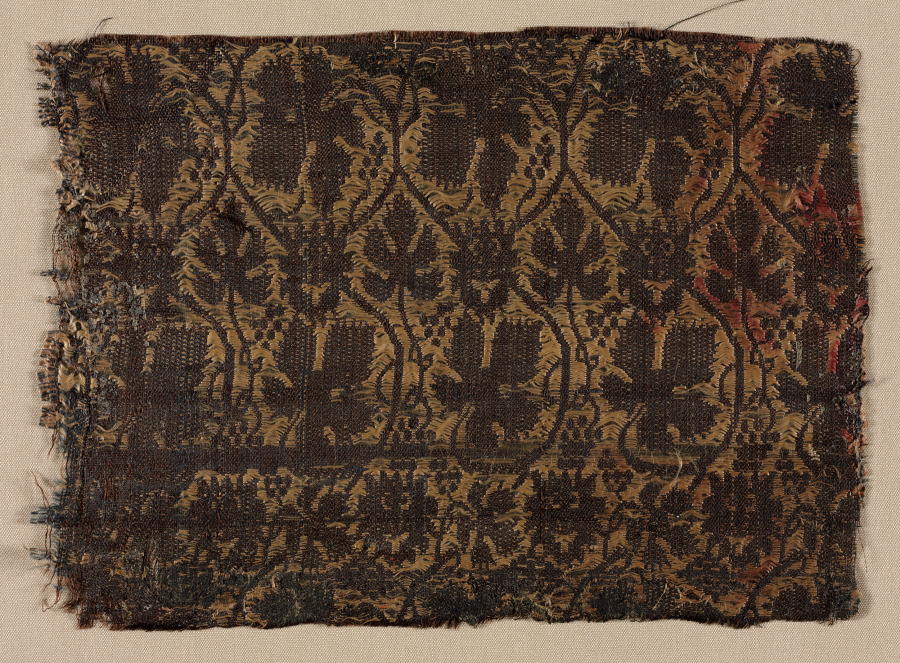
An Examination of Imperial Legacy in a Singular Fragment
One must approach this artefact not as a mere scrap, but as a sovereign entity. It rests, this fragment of silk, with the quiet authority of a concluded treaty. Its dimensions are deliberately modest, perhaps no larger than a gentleman’s pocket square, yet within its confines lies a cartography of absolute power. The material, as declared, is silk—but to leave the description at that would be akin to describing a bespoke rifle as mere metal and wood. This is Jin, the paramount Chinese silk, a fabric so intrinsic to the apparatus of empire that its very threads were, for centuries, a form of currency and a cipher of celestial mandate.
The Loom as Throne
The context, the legacy of imperial silk weaving, is not a backdrop but the very loom upon which this fragment was wrought. Consider the provenance. This silk did not emerge from a commercial mill; it was born within the sequestered, palatial confines of an Imperial Weaving Workshop, most likely in Jiangnan. These were not artisans in the common sense, but custodians of a sacred craft, operating under the direct patronage—and vigilant scrutiny—of the Ministry of Imperial Household. The patterns they wove were not subject to the vagaries of fashion, but to the immutable decrees of iconography. Every motif, every colour transition, was legislated.
Observe, here, the evidence. The density of the weave speaks of a thread count so exorbitant it would be deemed commercially ruinous on Savile Row. This was a deliberate exercise in resource-intensive superiority, a tangible manifestation of an empire’s boundless reach. The sheen, a deep, liquid radiance that seems to gather light rather than reflect it, is the result of filaments from the finest Bombyx mori caterpillars, fed exclusively on the leaves of the white mulberry. The hand, as we say of a good cloth, is sublime—a weightless, cool drape that belies its immense structural integrity. It is, in essence, the fabric of command.
A Heraldry of Symbols
Now, to the narrative encoded upon its surface. While the fragment is too small to reveal the grand, sweeping tableau of a full dragon robe, it is precisely this limitation that focuses the analysis. What remains is a corner of a larger cosmology. One can discern, perhaps, the sinuous curve of a cloud-scroll, its terminus still visible. This is no mere decoration. In the imperial lexicon, these stylised clouds represented the celestial realm, the auspicious ether from which the Son of Heaven derived his authority. Adjacent, one might find a sliver of a stylised mountain or a wave pattern—symbols of earthly stability and perpetual renewal, respectively.
The colour, however, is the most forthright declaration. If the fragment retains its original hue—a profound, resonant yellow—then its status is immediately elevated. This was the chromatic privilege of the emperor alone. To wear or possess this shade without sanction was not a faux pas; it was treason. Even if time has softened it to an ochre or gold, the intent remains legible. The dye, derived from precious gardenia or the sophisticated over-dyeing of safflower and indigo, was as controlled as the pattern books. This was a livery of power, a visual decree that separated the divine ruler from the governed multitude as effectively as any walled city.
The Quiet Weight of Provenance
Consider, then, the journey of such a fragment. It would never have entered the public market. A piece of this nature likely arrived in the West through the most discreet of channels: perhaps as a diplomatic gift from a Qing envoy to a European crown, later dispersed through aristocratic estates. Alternatively, it may have been carefully excised from a damaged or decommissioned robe by a collector of the Victorian era, a man who understood that a perfect fragment held more scholarly value than a compromised whole. Its edges are raw, not hemmed—a telling detail. This suggests it was never intended for use, but preserved as a specimen, a tactile reference of peerless quality.
In our contemporary context, this fragment transcends the archival. For the house of Lauren Fashion Heritage Lab, it serves as the ultimate benchmark. It is a masterclass in material integrity, in the marriage of profound symbolism to physical form. The lessons are not to be copied literally—the imperial system is, thankfully, not our model—but to be understood in principle. It teaches the tyranny of excellence, the non-negotiable pursuit of the finest material for its intended purpose. It demonstrates how pattern, when imbued with genuine meaning, elevates cloth to concept. It reminds us that true luxury is not merely expensive; it is significant, layered, and speaks in a whisper that carries across centuries.
This silk fragment, therefore, is far more than a relic. It is a silent arbiter of taste. It asks, by its mere existence, a most pressing question of any modern endeavour: does your work possess a fraction of this conviction, this seamless unity of matter and meaning? To hold it is to feel the weight of an empire’s aesthetic will, a standard against which all other claims of heritage must, however humbly, be measured.